
Using PK Modeling to Support Repeat-Dose Pharmacology Studies
Background
A biotech client developing a preclinical therapy for a renal disease needed to efficiently characterize the pharmacokinetic (PK) exposure and pharmacodynamics of a small molecule. Rather than conducting multiple standalone PK and PD studies, the team wanted to determine whether PK modeling from an initial single-dose study in mice could accurately predict repeat-dose exposure and streamline the overall research program.
The Challenge
Designing repeat-dose pharmacology studies often requires additional PK sampling to confirm that target drug exposures have been achieved. Conducting separate PK studies at each stage can increase timelines, animal use, and development costs.
The client needed a scientifically sound approach to predict repeat-dose exposure while maintaining confidence that the pharmacology data would accurately reflect the intended dosing strategy.
The Solution
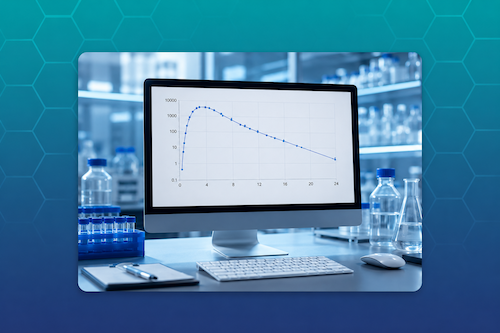
Xyzagen designed and executed a single-dose PK study in mice to characterize the compound’s pharmacokinetic profile. The resulting PK data were then used to develop a nonparametric superposition PK model to predict drug exposure under the planned repeat-dose regimen. The model estimated steady-state drug concentrations, Tmax, Cmax, and the duration that plasma concentrations remained within the desired pharmacologically active range.
During the subsequent repeat-dose study, PK samples were collected and compared against the model’s predicted exposures. This integrated approach enabled the team to directly evaluate the accuracy of the PK model while confirming drug exposure within the pharmacology study itself and have confidence on the pharmacological outcome.
The Results
The observed PK data from the repeat-dose study closely aligned with the model’s predicted steady-state exposure and concentration-time profile, validating the modeling approach and confirming that the pharmacology study achieved the intended drug exposure.
By combining experimental PK data with model-informed predictions, the project demonstrated that exposure could be accurately characterized without conducting additional standalone PK studies. This integrated approach increased confidence in study design while reducing the need for additional studies, helping the client make more informed development decisions with greater efficiency.
Final Takeaway
MIDD can streamline preclinical research by integrating PK modeling directly into pharmacology studies, reducing unnecessary studies while providing the exposure data needed to make confident development decisions. The impact:
- 3 Repeat-dose regimens predicted from initial single-dose PK data (this one is already confirmed)
- 2-3 additional standalone PK studies avoided
- 50-250 fewer animals required
- $30-60K in estimated study costs avoided